Salon.com recently posted a great slideshow of the most segregated cities in America. The post had a map of the racial breakdown of each city as well as an explanation of the history of segregation in each city. Check out the slideshow in this link.
What's interesting is that even in some of the most segregated cities, there is a new trend of young affluent white suburbanites moving into back into the core of cities and working class and middle class city black populations moving into inner-rung suburbs. While this new trend is causing some existing places to become more diverse as one population slides into a new neighborhood as the group is leaving, what's fascinating is that the new trend is still reinforcing the old trend of segregation. The shifts in population among races are not quite coexisting with each other as they are displacing one another.
And this displacement is causing a lot of ugly fights between new and existing populations throughout urban America. In Philadelphia and Washington D.C., historically black neighborhoods are trying to protect their community's identity from white and now black gentrifiers and in suburban Detroit, elite black suburbs or worried about the waves of working class blacks from inner-city Detroit moving into their communities.
These new tensions are now issues that planners now have to listen to and address. These tensions are no longer just a sensitive issue for the inner-city but now affect suburban planners as well. In my jurisdiction, my office worked on an historic black community (historic in culture but not in the building preservation sense) that began as a segregated community and had faced decades of discrimination. Their struggles in overcoming these obstacles helped cement the community's identity and it was very important that we preserve and honor that community's history. But from a strictly planning sense, none of their history of segregation was going to greatly affect how we planned and designed their future housing developments and open spaces. We could not ignore their history but we could not plan around their history either without a historical landmark or building. There was a disconnect between the community and the planners. To the community, their history was the number one concern. For the planners, designing safe spaces was our number one concern.
This disconnect between preserving the people's history in a community over the preservation of buildings is one of city planning's biggest challenges and up to now one of it's biggest failures. As a whole, city planners do not know how to at least help a community on the wrong side of gentrification. As city planners we almost always side with the gentrifiers because our number one goal is to create better designed spaces and buildings. The influx of gentrification helps remove and redevelop empty debris filled lots, rehabilitates vacant buildings and brings commercial vitality back into neighborhoods. Who wouldn't want that?
Newcomers into gentrified inner-city neighborhoods are often dismayed when they find out that it is the existing long term residents who do not want the positive changes of gentrification. The standard answer for newcomers to existing long-term residents is that they should be thanking them for improving their neighborhoods. The issue for long-term residents is not that they want to live in sub-standard conditions but they are seeking a permanent stake in their community in which they felt they established. Whether that neighborhood is an affluent community or a poor community, long term residents feel that it is their neighborhood in large part because of the history of segregation. A lot of older black inner-city neighborhoods were purposefully segregated and became the only neighborhoods blacks could live in within a metropolitan region.
Despite their struggles these older black communities formed identities that were important not only to the psyche of blacks that lived in that community but to urban black America as a whole...for that time. Over time, these communities have often lost their identities as segregation slowly ended and middle class blacks moved out, leaving some of the working class blacks who couldn't afford to leave feel abandoned. But even with all that said there is still some high reverence for some of these communities no matter how poverty stricken or crime riddled they have become. While saying you are from Harlem or the Southside of Chicago or the 9th Ward of New Orleans may be looked down upon by some, for some in urban black America it is still a source of pride.
And this source of pride, which is wrapped around decades of segregation, self-empowerment, decline and then decades of poverty is what gentrification threatens to end. These communities have seen the life cycles of the black community within those cities and while they may be dying, those that still live in those communities do not want to see it end. So how do we as planners preserve that sense of pride? We all know that cities and neighborhoods go through changes, death and rebirth. Do we interfere with the natural life cycle of neighborhoods? Or is it important to maintain the cultural identity of a place like Harlem from becoming just another nice gentrified neighborhood?
What are your thoughts? Thanks for reading!
Showing posts with label Detroit. Show all posts
Showing posts with label Detroit. Show all posts
Wednesday, March 30, 2011

Monday, October 4, 2010
Detroit shatters stereotypes of blight
Swiped from VBS.TV:
In August 2009, Vice published a story called "Something, something, something, Detroit: Lazy journalists love pictures of abandoned stuff," about the roving gangs of photojournalists prowling the empty city and feasting on its highly photogenic carcass. Since then, some of the worst offenders have abashedly changed their approach to covering Michigan's largest city. But most outlets are still fixated on the all-you-can-click pageview buffet that is "misery porn" of the decaying Motor City.
Last month, we traveled to Detroit with co-creator and star of the "Jackass" empire Johnny Knoxville to explore what lies gasping beneath the rubble of over-indulged industry, frighteningly embarrassing municipal mismanagement, and decades' worth of social and economic imbalance. What we found is a burgeoning class of creative young folk intent on rebuilding their communities and the city, despite being faced with a world that has already phoned in their city's obituary.
Tuesday, September 21, 2010
Cool Maps: Race Cartography
Michael Jackson was wrong, apparently it does matter if you are black or white according to these maps:

A racial integration map of NYC
From Gawker:
Photographer Eric Fischer's color-coded maps of racial segregation are captivating, particularly once you find your own neighborhood. A look at his work follows after the jump, courtesy of Fast Company's Cliff Kuang.
Eric Fischer saw those maps, and took it upon himself to create similar ones for the top 40 cities in the United States. Fisher used a straight forward method borrowed from Rankin: Using U.S. Census data from 2000, he created a map where one dot equals 25 people. The dots are then color-coded based on race: White is pink; Black is blue; Hispanic is orange, and Asian is green.

Harmony in Detorit
These maps are pretty interesting and show how much progress some cities have made toward integration and how far some cities still have to go. What's interesting is that in some of the more liberal cities like New York City and Washington D.C. there are still hard division lines when it comes to race. In southern cities, where people tend to think there would be more segregation but in southern towns and cities black neighborhoods and white neighborhoods have almost always been in close proximity to one another...even if they were completely seperate. But these neighborhoods would share the same main streets and downtowns as opposed to cities in the Northeast where black neighborhoods have their own seperate main streets, commercial corridors and malls.

A racial integration map of NYC
From Gawker:
Photographer Eric Fischer's color-coded maps of racial segregation are captivating, particularly once you find your own neighborhood. A look at his work follows after the jump, courtesy of Fast Company's Cliff Kuang.
Eric Fischer saw those maps, and took it upon himself to create similar ones for the top 40 cities in the United States. Fisher used a straight forward method borrowed from Rankin: Using U.S. Census data from 2000, he created a map where one dot equals 25 people. The dots are then color-coded based on race: White is pink; Black is blue; Hispanic is orange, and Asian is green.

Harmony in Detorit
These maps are pretty interesting and show how much progress some cities have made toward integration and how far some cities still have to go. What's interesting is that in some of the more liberal cities like New York City and Washington D.C. there are still hard division lines when it comes to race. In southern cities, where people tend to think there would be more segregation but in southern towns and cities black neighborhoods and white neighborhoods have almost always been in close proximity to one another...even if they were completely seperate. But these neighborhoods would share the same main streets and downtowns as opposed to cities in the Northeast where black neighborhoods have their own seperate main streets, commercial corridors and malls.
Friday, March 5, 2010
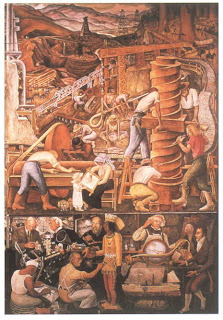
Diego Rivera
Diego Rivera was a Mexican painter and muralist born in Guanajuato City, Guanajuato. Studied painting in Mexico before going to Europe in 1907.While in Europe he took up cubism and had exhibitions in Paris and Madrid in 1913; he then had a show in New York City in 1916. In 1921 he returned to Mexico, where he undertook government-sponsored murals that reflected his communist politics in historical contexts.
.
His personal life was as dramatic as his artwork. In 1929, he married Kahlo who was roughly 20 years younger. The two had a passionate, but stormy relationship, divorcing once in 1939 only to remarry later. She died in 1954. He then married Emma Hurtado, his art dealer. Rivera died of heart failure on November 24, 1957, in Mexico City, Mexico. Rivera's talent for historical murals and his tributes to earthy folk traditions made him one of the most influential artists in the Americas and one of Mexico's most beloved painters.

Market in Tenochtitilan
 Pan American Unity
Pan American Unity

Totanac Civilization

The World

Detroit Inudstry Mural North

Detroit Inudstry Mural South
Wednesday, December 23, 2009
Urban Art Helps Detroit Cope With Hard Times
In a city laid low by hard times, surprising sights are popping up on the streets of Detroit.
Sunday, August 30, 2009
Eminem - Beautiful
After seeing the past video of Detroit on the move, this video shows the same buildings which were being built in the 1960's now in decay.
DETROIT: City on the Move (Part 1)
This public domain film narrated by then-mayor Jerome P. Cavanaugh was made in 1965 to promote Detroit. The city faced many urban problems and its population was in decline. These difficulties were amplified by the 1967 riots, which are seen by many as one of the most significant events which led the city into a forty year decline. Since the mid 50s, the population has dropped by half and the infrastructure has been destroyed or has decayed due to abuse and neglect.
Detroit

I have never been to Detroit but I always have a fondness for cities like it because they will never be what they once were. I primarily grew up in Baltimore and spent a lot of time in Philadelphia so I understand what it feels like to see a city past it's glory years. No matter how much time as planners we spend to make our overall city environments better, we know that the factories that helped build our towns and cities and the factory workers who lived in them, are not coming back. The barren industrial landscapes are not only eyesores but they continue to decay into decrepit architectural skeletons.
.
While others mock Detroit's struggles or just write it off as a forgotten city, I have great sympathy for a city which helped create our modern way of life. A large part of who we are and how we define ourselves was built off of Detroit Labor and for that I don't feel it is right that we turn our back to the city now that it is struggling. I understand that we are a free market capitalist society and that industries come and go and it is up to cities to plan better for it's peaks and valleys. I am also certain that the city and state governments as well as the major car companies did not have a proper plan in place for the city's future and in those respects, the city was destined to fail. But ask yourself, on a historical level, where would we be as a country, without Detroit?
.
Detroit was a great American industrial jewel that we are allowing to crumble like the ruins in Rome. The only catch is that Detroit has not been deserted. Among these industrial ruins is the nation's 11th largest city where over 900,000 people reside. Our nation's forgotten major city is still larger then the cosmopolitan cities of San Fransisco, Boston, Seattle and Washington D.C. While we can never bring Detroit back to what it was 50 years ago, we can still transform the city from a once great industrial city into a great historical city and not watch city turn into a ruin from a far.


"Despite the ugliness that is inherent in these photos: the ugliness of poverty, the tragedy of loss, and waste, this building still lets us glimpse something beautiful. In Detroit this beauty is uniquely sustained. In other cities, buildings like this would be turned into luxury loft condominiums. They would be knocked down so that something new could be built in their place, their contents dragged off to a landfill and forgotten. Here we get to see what the world will look like when we're gone. We see that the world will indeed go on, and there is a certain beauty to nature's indifference."
Text copyright and pictures 2008, James D. Griffioen
Wednesday, June 17, 2009
Detroit Graffiti
This editorial and photos was taken by Dylan Reid from the Spacing Toronto Blog. It's amazing how many abandoned high-rises Detroit has. In the first picture below you can see trees growing on the roof tops.
Swipe:
"Detroit must be some kind of graffiti artist heaven — there are almost endless amounts of deserted, empty walls across the city in neglected streets and abandoned factories and buildings, and a City government that must have much bigger priorities for its limited resources.
...Detroit has one thing other cities don’t have — entire high-rise buildings that are deserted — and it has developed to a high art a form of graffiti that uses the windows of buildings."


Swipe:
"Detroit must be some kind of graffiti artist heaven — there are almost endless amounts of deserted, empty walls across the city in neglected streets and abandoned factories and buildings, and a City government that must have much bigger priorities for its limited resources.
...Detroit has one thing other cities don’t have — entire high-rise buildings that are deserted — and it has developed to a high art a form of graffiti that uses the windows of buildings."
Wednesday, April 1, 2009
Top 10 Largest Cities Observation

A lot of people have been dumping on Detroit bringing up a myriad of negative statistics (such as the average housing price for the city is below $20K) about the struggling city. With abandoned skyscrapers and so many vacant parcels that have been reclaimed for farms, it is easy to get the perspective that Detroit is a ghost town. In Actuality it is a top 10 city with over 950,000 residents making it significantly larger then cities such as Atlanta, Denver and D.C.
Despite Detroit losing more then half of it's population since 1950 and the city of Houston almost doubling since the same time, Detroit still has more than twice the density of Houston according to the 2000 census. So go figure, even a shelled out city has more density then a sprawled out city.
Wednesday, February 18, 2009
America's Emptiest Cities
Forbes Magazine recently just listed Las Vegas as America's emptiest cities based on housing and rental vacancies. To see the entire list click here. Las Vegas, which was one of America's fastest growing cities, now has more vacancies then to Detroit, whose struggles have been well chronicled. Even though this is a dubious distinction for Sin City, one can't find it surprising given the current economic and housing crisis happening across the country. Still it is pretty shocking to see a place with unprecedented growth begin to fall on hard times even if it's economy was based on luxury and excess.
Also not surprising was the fact that Atlanta came in third place. There is only so much money you can charge for rent and housing for a low density sprawled out city. Although overall, housing prices are cheaper in Atlanta compared to other major cities however the Atlanta area still saw a spike in Housing prices within the last 5 years.
A quote from the article:
"As real estate prices skyrocketed during the boom, consumers took out massive loans to buy homes, assuming values would continue to rise. Instead they took a nosedive, especially in places like Las Vegas, Florida and Phoenix, where the housing boom had created excess inventory and so-called "bad loans" were rampant. Many homeowners suddenly found themselves with properties worth far less than the mortgages they'd taken out. In the worst cases, banks foreclosed, leaving people without homes--and with more debt than they'd had to begin with."
How ironic that Las Vegas and Detroit, two cities that could not be any more different, may share the same fate in the end by being single industry cities.
Also not surprising was the fact that Atlanta came in third place. There is only so much money you can charge for rent and housing for a low density sprawled out city. Although overall, housing prices are cheaper in Atlanta compared to other major cities however the Atlanta area still saw a spike in Housing prices within the last 5 years.
A quote from the article:
"As real estate prices skyrocketed during the boom, consumers took out massive loans to buy homes, assuming values would continue to rise. Instead they took a nosedive, especially in places like Las Vegas, Florida and Phoenix, where the housing boom had created excess inventory and so-called "bad loans" were rampant. Many homeowners suddenly found themselves with properties worth far less than the mortgages they'd taken out. In the worst cases, banks foreclosed, leaving people without homes--and with more debt than they'd had to begin with."
How ironic that Las Vegas and Detroit, two cities that could not be any more different, may share the same fate in the end by being single industry cities.
Monday, December 29, 2008
Returning Detroit Back to Nature

A recent AP article covered what I think is one of the most fascinating "urban renewal" projects occurring in Detroit right now, which is Urban Farming. With the city's population less than half of what it was in 1950 there are thousands of empty lots in Detroit that are being converted into mini-farms.
The AP article quotes:
"With enough abandoned lots to fill the city of San Francisco, Motown is 138 square miles divided between expanses of decay and emptiness and tracts of still-functioning communities and commercial areas. Six barren acres of an estimated 17,000 have already been turned into "mini-farms," demonstrating the lengths to which planners will go to make land productive."
To me the irony of Detroit, one of America's most industrialized cities where car production was revolutionised which created negative environmental conditions such as smog and helped cities decentralize only to be converted back into a farm is fitting. We have all seen the Disney Cartoon of the little house that eventually got surrounded by the big city but we have never seen the big city go into reverse. The only times we have seen big cities go in reverse are in a apocalyptic fantasies where nature consumes cities after the people have vanquished. But to see the people return the city into a farm has to be a new chapter in the history of city development. Could this be a new chapter in city planning history that the fate of all cities could face that somehow Detroit had fast forwarded through time to reach this eventual conclusion?
The last question posed is very interesting because while Detroit is one of the biggest cities in the rustbelt of the U.S. it is not alone in the declining population and property value of it's city. There are dozens of small towns and cities across Michigan, Ohio and Pennsylvania whose fates were dependent on industry which appears will never return. Can Detroit be a model of a new green city in the rustbelt? Can these industrial towns despite the decades worth of toxins in the ground actually produce a life sustaining farm? I was always told by planning professors that once farmland is developed that it can return back to farmland again - is Detroit proving that theory wrong?
What is your opinion?
Sunday, December 21, 2008
We Almost Lost Detroit
The Associated Press reports:
DETROIT (AP) — Some statistics conveying the breadth of challenges facing the city of Detroit:
916,952: Detroit's latest official population, down from peak of about 1.8 million in 1950s. In a city of 139 square miles, that gives Detroit a population density about half of Chicago's.
201,000: Residential taxpayers in Wayne County, which is dominated by Detroit, who were tax delinquent in October, out of a total of 857,000.
19,708: Violent crimes recorded by FBI for Detroit in 2007, giving it highest violent crime rate of any major U.S. city. San Diego and San Antonio, each with 50 percent more people than Detroit, had less than half as many violent crimes.
$18,513: Average sale price of a Detroit home so far in 2008, down from $40,011 in 2007, according to Detroit Board of Realtors. Average sale price in neighboring Oakland County is $153,695.
47.8: Percent of Detroit children in 2007 who lived below poverty line of $21,000 for a family of four. For children nationally, the rate was 18 percent. Detroit's overall poverty rate of 33.8 percent was highest of any major city.
21.6: Detroit's unemployment rate, according to latest Census Bureau figures for 2005-07. Of all U.S. cities with more than 20,000 residents, only Muskegon, Mich., had a higher rate, at 22.1 percent.
15: Candidates competing in a special mayoral election called after Kwame Kilpatrick was jailed for trying to cover up a text-messaging sex scandal.
14: Losses so far for Detroit Lions en route to what could be National Football League's first 0-16 season.
3: Days each week that Detroit's two newspapers will offer home delivery, as part of new cost-cutting plan.
Friday, November 9, 2007
Great City Planning Documentaries
The City, Parts I, II (1939)
A documentary which pleas for less development in the inner city while promoting what we call today, urban sprawl.
http://www.archive.org/details/CityTheP1939
http://www.archive.org/details/CityTheP1939_2
A Place to Live (1948)
This documentary was about slum clearance in Philadelphia. For any who has lived in Philadelphia, you will get a kick out of the new upscale housing project known as "The Richard Allen Housing Projects." These projects were some of the worse projects in the country. They were eventually torn down in 1999.
http://www.archive.org/details/PlacetoL1948_2
The Dynamic American City (1956)
A 1950's documentary which is advocating the removal of blighted neighborhoods through Urban Renewal.
http://www.archive.org/details/DynamicA1956_2
Community Growth & Crisis (1959)
Every Planner should watch this film. This is a documentary about homebuilders decrying unplanned urban sprawl. Their solution? Planned Unit Developments, Cluster Zoning, Flexible zoning controls and Pro Land Use laws... if only we had listened
http://www.archive.org/details/Communit1959
Detroit: City on the Move (1965)
And after the King riots in 1968, the city residents were on the move to the suburbs. Such high hopes for the city in the mid 1960's. Has there been a major American city that has fallen harder than Detroit?
http://www.archive.org/details/DetroitC1965
A documentary which pleas for less development in the inner city while promoting what we call today, urban sprawl.
http://www.archive.org/details/CityTheP1939
http://www.archive.org/details/CityTheP1939_2
A Place to Live (1948)
This documentary was about slum clearance in Philadelphia. For any who has lived in Philadelphia, you will get a kick out of the new upscale housing project known as "The Richard Allen Housing Projects." These projects were some of the worse projects in the country. They were eventually torn down in 1999.
http://www.archive.org/details/PlacetoL1948_2
The Dynamic American City (1956)
A 1950's documentary which is advocating the removal of blighted neighborhoods through Urban Renewal.
http://www.archive.org/details/DynamicA1956_2
Community Growth & Crisis (1959)
Every Planner should watch this film. This is a documentary about homebuilders decrying unplanned urban sprawl. Their solution? Planned Unit Developments, Cluster Zoning, Flexible zoning controls and Pro Land Use laws... if only we had listened
http://www.archive.org/details/Communit1959
Detroit: City on the Move (1965)
And after the King riots in 1968, the city residents were on the move to the suburbs. Such high hopes for the city in the mid 1960's. Has there been a major American city that has fallen harder than Detroit?
http://www.archive.org/details/DetroitC1965
Subscribe to:
Comments (Atom)