Thursday, March 31, 2011

Saturday, January 1, 2011
Thursday, December 16, 2010
The Ghost Cities of China
The hottest market in the hottest economy in the world is Chinese real estate. The big question is how vulnerable is this market to a crash.
One red flag is the vast number of vacant homes spread through China, by some estimates up to 64 million vacant homes.
We've tracked down satellite photos of these unnerving places, based on a report from Forensic Asia Limited. They call it a clear sign of a bubble: "There’s city after city full of empty streets and vast government buildings, some in the most inhospitable locations. It is the modern equivalent of building pyramids. With 20 new cities being built every year, we hope to be able to expand our list going forward."

No cars on the street

Empty $19 Billion Development

Empty Desert City

Empty Residential Towers

Ordos Museum...Empty
Photo credits belong to the Business Insider
Tuesday, April 13, 2010
Saturday, March 20, 2010
Friday, March 5, 2010
Graffiti Chile: Grin


Photos by: KELP (www.kelp.cl)
Diego Rivera

Market in Tenochtitilan
 Pan American Unity
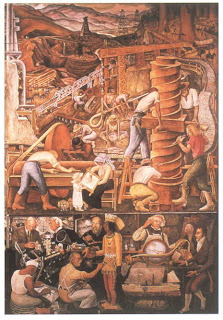
Pan American Unity

Totanac Civilization

The World

Detroit Inudstry Mural North

Detroit Inudstry Mural South
Thursday, January 21, 2010
Havana Bombings - a documentary short
Graffiti artists and members of their communities discuss graffiti culture in Havana, which takes very different forms in Cuba than it does in the United States.
INVISIBLE CITY
In the inner-city housing project of Toronto's Regent Park, Kendell and Mikey, like their surroundings are in the process of transformation; the environment and social pressure tempting them to make poor choices, their mothers and mentors rooting for them to succeed.
Turning his camera on the often ignored inner city, Academy-award nominated director Hubert Davis sensitively depicts the disconnection of urban poverty and race from the mainstream.
PLAYING AT HOTDOCS 2009 : http://www.hotdocs.ca
Tuesday, January 19, 2010
'Wavin' Flag' by K'naan (Official World Cup Theme Song)
Please text 'Yéle' to 501501 to donate $5 to Yéle Haiti. Your money will help with relief efforts. They need our help.
(Tweeted by) Wyclef Jean, the text message went out to nearly 1.4 million followers and kicked off what has quickly become the largest text-based fundraising campaign for disaster relief in history.
"This is the first time there has been a major disaster when this type of service has been widely available," says Yéle Haiti executive director Hugh Locke, whose nonprofit will use the funds to send nutrition bars, candles, hand-cranked flashlights and blankets to Haiti on two FedEx planes this Friday. "People want a sense of participating in the response. There is an emotional need to do something," he adds.
For the Haiti crisis, Yéle's technology partners Mobile Giving and Give on the Go have waived their typical waiting period of two weeks to deposit the donations. Firms like Mobile Accord — which manages the Red Cross system, among others — pay out donations on a quarterly basis, after customers have paid their cell-phone carriers (they) forwarded the money, 100% of which goes toward relief efforts.
Architecture for Humanity
Here is part of their long term plan:
For those of us who are part of the reconstruction effort, we need to think about immediate needs for shelter while planning for the next three to five years of rebuilding.
When we are rebuilding, do not let the media set the time line and expectations for reconstruction. I remember vividly well known news personalities standing on the rubble of homes in the lower ninth proclaiming that 'this time next year we will see families back home.' Some well meaning NGOs, who usually have little building experience, are even worse -- 'we'll have 25,000 Haitians back home if you donate today.' In reality, here is what it really looks like:
- Pre-Planning Assessments and Damage Analysis (underway, will run for a year)
- Establish Community Resource Center and Reconstruction Studio (Week 6 to Month 3)
- Sorting Out Land Tenure and Building Ownership (Month 6 to Year 5)
- Transitional Shelters, Health Clinics and Community Structures (Month 6 to Year 2)
- Schools, Hospitals and Civic Structures (Month 9 to Year 3)
- Permanent Housing (Year 1 to Year 5)
1. Set up Community Resource Centers to bring architecture and building services to folks on the ground. See below for more details.
2. Translate and distribute of our Rebuilding 101 Manual.The manual was originally developed after Hurricane Katrina and widely used in the rebuilding process.
3. Adapt, translate and distribute a Earthquake Resistant Housing Manual for local NGOs and community groups.
4. Provide Architectural and Construction professionals to develop and build community facilities inc. schools and medical centers
5. Train and Educate Incoming Volunteers in building safely and to emphasize the need for sustainable materials and construction techniques.
6. Complete the Youth Sports Facility and Disaster Recovery Center just north of Port au Prince that was developed in 2009.
7. Design, develop and implement community and civic structures for various clients and local community partners. This includes the reconstruction and building schools given the particular loss in structures.
Thursday, January 14, 2010
Disaster Planning
While I most certainly send my sincerest hopes and prayers that Haiti can overcome their most immediate crisis as quickly as possible, I wonder about what will be the fate of Port Au Prince, one year from now, five years from now and ten years from now. There are a lot places around the globe that have been impacted by natural disasters and have chosen not to rebuild because of the staggering costs of repairs. More recently, the location of development that are prone for natural disasters has come into question, leaving many government officials and the public wondering if the development should be rebuilt at all.
Haiti does not have that option. Even though the infrastructure to their capital has been destroyed they do not have the option of abandonment. Port Au Prince was not only the capital but also the hub of government services for the entire nation. Port Au Prince was also Haiti’s largest city that made it the commercial, industrial and social hub of the nation as well. The city has to be rebuilt…but how?
The city will need planners to come up with an immediate disaster plan along with a new Master Plan for rebuilding and growth for the future. Part of the reason why this disaster is so catastrophic is that there was no Master Plan in the city to begin with and growth occurred anywhere and everywhere haphazardly. Now whether a city with a weak central government can enforce that Master Plan is another story. However there are more than a few cities in developing plan that have been able to control growth and development through a Master Plan. And right now, Port Au Prince does not have a choice, in order to save the future of the city and perhaps the nation, a Master Plan is needed to sort out the chaos and shock of a complete government breakdown and destruction.
The immediate concerns are that the city needs everything right now. But when the immediate crisis is over, be it months or years from now there will have to be a plan on what, when and how the city will be rebuilt. There is no functional starting point to build off of right now in Port Au Prince. Do you rebuild housing first to shelter a city where all the residents have been displaced. Or do you focus on rebuilding stores since there is nowhere for people to buy food, clothing or cleaning supplies. Or do you rebuild the hospitals first? And in what order do you rebuild government buildings, schools and job sectors? All of these questions must be in accordance of a disaster plan and a future Master Plan.
The city cannot be rebuilt all at once. There are certain segments of the city that planners and residents are going to have to choose to rebuild first. The city will have to be rebuilt at a segment at a time, block-by-block, neighborhood-by-neighborhood at a time in accordance to a plan. If the city rebuilds in a piecemeal fashion then there will be properties in the city that will be left as unstable rubble for years and decades by property owners who cannot afford to rebuild or have gone missing.
There will also be some hard questions that planners and residents of the city will have to face in rebuilding the city. There is going to be questions of whether a city on a major fault line should be rebuilt. Because of that question, the city cannot rebuild in the same pattern and function as it did before the earthquake. While many who rebuild may not be able to have expensive earthquake retrofitted buildings like in Los Angeles and Tokyo, new building standards can be set in place to reinforce concrete construction with steel. If this cannot be done for all construction it should at least occur in major government institutions, hospitals and schools.
Other questions the city will have to face is whether construction should be allowed on the hill tops closest to the fault line. Housing construction on the hill and mountaintops would not only be a potential hazard it has also contributed to deforestation, which has also contributed to massive flooding. The placement of the city’s transportation infrastructure may have to relocate. While the airport only received moderate damage, the blockages to this vital transportation hub has made it almost impossible to deliver resources to the rest of the city. These ports in the future will need to be isolated and not located in the heart of the city. Lastly, what will the city do with the tons of crushed concrete slabs? What took generations to build by piecemeal will not have to be cleared in a massive fashion.
All of these questions are all apart of major disaster planning and city master planning that has to be addressed soon. Without a plan on how to redevelop the city’s current plight and its future reconstruction, the city will not be able to recover by piecemeal construction.
Tuesday, January 5, 2010
Tuesday, December 15, 2009
Kingston
BlackAtlas Travel Expert Nelson George takes you on a trip through Kingston. View more of Nelson's videos online at www.blackatlas.com.
Monday, November 16, 2009
Informal Cities
An excerpt from Robert Neuwirth's Lecture 'The Extroverted City of System D' a contribution to the book Open City:
In Lagos, everything is informal. The bus system is informal—the government got out of mass transit business decades ago (though it has recently stepped back into public transport with a bus rapid transit line) and the system that includes more than 75,000 danfos was held together informally by the National Union of Road Transport Workers as one-part mass transit and one-part Ponzi scheme. One of the largest formal supermarkets in Lagos buys most of its product from informal wholesalers. Some major multinationals here distribute their products through informal networks. And informal merchants invest in the formal world.
Authorities in the city acknowledge that as much as 80 percent of the work force—and Lagos has between nine and 17 million inhabitants, depending on where you draw the boundaries and who’s doing the counting—is involved in the informal sector. The federal government also suggests that somewhere around 60 to 70 percent of the country’s economic activity derives in some way from the informal sector—and this means that, in aggregate, merchants like Prince Chidi Onyeyirim and Fatai Agbalaya are more important to Nigeria’s future than Shell, Mobil, and Chevron, the multinational oil giants that pump sweet crude from the Niger River Delta.
As Mega-Cities continue to explode in population around the world (particularly in Africa) they continue to stretch the conceptual frameworks of what cities were meant to be and how they are organized. Most modern cities may appear to chaotic but when examined closely, they are heavily structured and organized systems that control and dictate the flow of traffic, development, water, sewage, air and open space. The lack of those uniform structural systems in dense urban places creates chaos and challenges the belief of whether that urban place is truly a defined city jurisdiction with a definitive boundaries to the city's power of influence and control. The uninformed mega-cities of today have no beginnings and endings to the jurisdiction's scope of power.
Monday, October 5, 2009
Rio de Janeiro - Olympic games 2016 ( facilities and city tour ) - Master plan
Pretty F'ing Impressive
Wednesday, September 23, 2009


Monday, August 31, 2009
Will Africa soon become an Urban Continent?

"…Africa is still something of a demographic outlier compared with the rest of the developing world. Long berated (or loved) as the sleepiest continent, it has now become the fastest-growing and fastest-urbanising one. Its population has grown from 110m in 1850 to 1 billion today. Its fertility rate is still high: the average woman born today can expect to have five children in her child-bearing years, compared with just 1.7 in East Asia. Barring catastrophe, Africa’s population will reach 2 billion by 2050. To get a sense of this kind of increase, consider that in 1950 there were two Europeans for every African; by 2050, on present trends, there will be two Africans for every European (see chart 1).
…One African in two is a child. The numbers are such that traditional ways of caring for children in extended families and communities are breaking down…
…Africa’s rate of urbanisation is the fastest the world has ever seen, says Anna Tibaijuka, the head of Habitat, the UN agency responsible for urban development. In 1950 only Alexandria and Cairo exceeded 1m people. When the city rush is done, Africa may have 80 cities with more than 1m people, plus a cluster of megacities headed by Kinshasa, Lagos and Cairo—none of which show signs of mass starvation. Intermediary towns of 50,000-100,000 people will soak up most of those coming from the countryside. Urbanisation is part of the solution to Africa’s demographic problems, not a manifestation of them."
The biggest question I have is whether African cities will adopt city planning methods to strategically plan and control growth and not let new development grow haphazardly as seen in other developing nations. There are several urban locales in South and Southeast Asia that have dense populations of 1 million people or more but they hard to define as cities. They appear to be more of a collection of dense high rise developments or communities that all function independently of each other. The same can be said of many current African cities today. Hopefully small African cities now that are expected to explode in population can implement plans now before they become overrun with major developments.
Another question I have for anyone to answer is how will Africa becoming a more urban continent change your perception of the continent?